₹2.27 Crore CSR Oxygen Development Project Faces Demand for Independent Audit and Transparency Review in Janjgir-Champa




MEDIA HOUSE MPCG | NATIONAL INVESTIGATIVE DESK
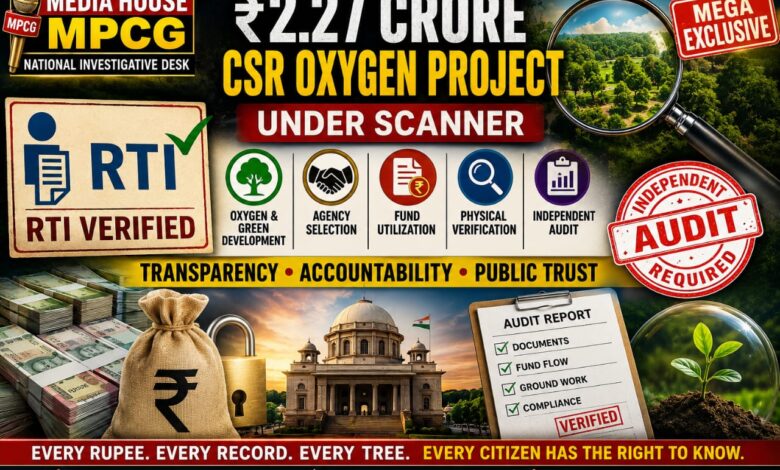
🚨⚖️ ₹2.27 CRORE CSR OXYGEN DEVELOPMENT PROJECT UNDER THE SCANNER
🌳💰 “Fund Utilization, Agency Selection & Ground Execution: Is a High-Level Independent Audit Now Imperative?”
🏛️ Public Accountability • Financial Governance • Environmental Stewardship • Administrative Transparency
🔴━━━━━━━━━━━━━━━━━━━━━━━━━━━━━━━━━━━━━━━━━━━━━━━━━━━━🔴
🚨🔥 MEGA EXCLUSIVE | A PROJECT, A PUBLIC QUESTION, AND A TEST OF GOVERNANCE
In a development that has triggered significant public-interest discourse within administrative and policy circles, a CSR-funded “Oxygen Creation & Development Project” sanctioned at approximately ₹2.27 Crore in District Janjgir-Champa has become the subject of a demand for an independent, multidisciplinary scrutiny.
The issue extends far beyond a routine administrative sanction. At its core lies a larger governance question involving Public Fund Accountability, Financial Transparency, Institutional Due Diligence, Environmental Governance, Project Monitoring Mechanisms and Administrative Responsibility.
Available records indicate that nearly 50 percent of the sanctioned amount—approximately ₹1.13 Crore—was reportedly released as the first installment. Subsequently, questions have been raised regarding implementation methodology, agency selection rationale, physical progress indicators, documentation integrity and compliance with standard governance principles.
The complaint does not seek to establish guilt; rather, it calls for a transparent verification of facts, records and ground realities so that public confidence in governance systems remains protected.
—
🔍⚡ CASE PROFILE: WHY HAS THIS PROJECT ATTRACTED ATTENTION?
The project has reportedly been conceptualized under an environmental enhancement framework involving green infrastructure, plantation-based development, oxygen augmentation and ecological improvement initiatives.
However, multiple governance-related questions have now emerged.
Key Concerns Raised:
✔️ Whether all statutory, financial and technical procedures were followed before project execution.
✔️ Whether the released funds correspond proportionately with measurable physical progress.
✔️ Whether the implementing agency was selected through a transparent and technically justified process.
✔️ Whether documentation, expenditure and on-ground execution are mutually consistent.
✔️ Whether monitoring and verification mechanisms functioned effectively.
These questions have prompted calls for an Independent Administrative, Technical and Financial Review.
—
🏛️⚠️ THE AGENCY SELECTION QUESTION: A CRITICAL GOVERNANCE ISSUE
One of the most significant aspects highlighted in the complaint concerns the rationale behind the selection of the implementing agency.
Environmental development projects generally require expertise in:
🌿 Ecological Planning
🌳 Plantation Management
🌎 Environmental Sustainability
📊 Impact Assessment
🌱 Green Infrastructure Development
Accordingly, the following issues have been flagged for examination:
🔹 Was a formal Technical Evaluation Committee constituted?
🔹 Were alternative competent agencies comparatively assessed?
🔹 Was inter-departmental consultation undertaken?
🔹 Does the record contain objective criteria supporting the selection decision?
🔹 Is the selection process demonstrably transparent and administratively defensible?
Experts observe that institutional transparency in agency selection forms the foundation of public trust in any large-scale developmental intervention.
—
💰📊 FUND RELEASE VS PHYSICAL EXECUTION:
THE CORE AUDIT QUESTION
Perhaps the most consequential issue emerging from the complaint concerns the relationship between financial disbursement and actual project implementation.
The complaint seeks verification of:
📌 Date-wise fund release chronology
📌 Expenditure trail
📌 Measurement Book (MB) entries
📌 Technical certification records
📌 Work commencement documentation
📌 Progress monitoring reports
📌 Geo-tagged photographic evidence
📌 Site verification reports
📌 Utilization Certificates
📌 Contractor/vendor engagement records
The central inquiry remains straightforward:
“Does the documented expenditure correspond with objectively verifiable ground execution?”
This question lies at the heart of every public expenditure audit.
—
📜⚖️ DOCUMENTARY EVIDENCE THAT MAY REQUIRE PRESERVATION
Governance specialists frequently emphasize that the integrity of records is indispensable for any credible inquiry.
The complaint therefore recommends immediate preservation of:
Administrative Approval Files
Technical Sanction Records
CSR Approval Documentation
Agency Selection Files
Tender & Procurement Documents
Contract Agreements
Fund Release Orders
Banking Transaction Records
Utilization Certificates
Measurement Books
Inspection Reports
Monitoring Reports
Geo-Tagged Project Evidence
Correspondence Files
Internal Review Notes
Such documentation may prove critical in establishing a complete audit trail.
—
🚨🔍 WHY THIS MATTER EXTENDS BEYOND A SINGLE PROJECT
Policy experts argue that this matter has implications extending beyond one development initiative.
At stake are broader principles of:
🏛️ Institutional Credibility
📊 Financial Discipline
⚖️ Administrative Accountability
🌎 Environmental Governance
💰 CSR Resource Efficiency
📢 Public Trust
When questions arise regarding a publicly funded project, transparency becomes not merely desirable but essential.
The objective is not controversy.
The objective is credibility.
—
🌐⚠️ FINANCIAL FORENSICS PERSPECTIVE
Financial governance specialists often recommend a layered audit framework in projects involving substantial public or CSR funding.
Level 1: Documentary Audit
Verification of approvals, sanctions and procedural compliance.
Level 2: Financial Forensic Review
Tracing fund flow, expenditure patterns and utilization consistency.
Level 3: Technical Audit
Independent evaluation of work quality, quantity and execution status.
Level 4: Physical Verification
Ground inspection supported by geo-tagging and videographic evidence.
Level 5: Accountability Mapping
Identification of decision-making authorities and oversight responsibilities.
Such a framework helps distinguish procedural compliance from substantive implementation.
—
📢🔥 PUBLIC INTEREST DIMENSIONS
Should any mismatch eventually be established between sanctioned objectives, financial expenditure and actual execution, the implications could affect:
🔹 Governance Credibility
🔹 Environmental Outcomes
🔹 CSR Effectiveness
🔹 Public Resource Management
🔹 Citizen Confidence
Conversely, if all procedures are found compliant, an independent inquiry could reinforce institutional credibility and public trust.
Thus, transparency serves both accountability and administrative legitimacy.
—
⚖️🏛️ WHAT THE COMPLAINT SEEKS
The complaint primarily seeks:
✔️ Independent High-Level Inquiry
✔️ Technical Audit
✔️ Financial Audit
✔️ Physical Verification
✔️ Geo-Tagged Assessment
✔️ Record Preservation
✔️ Videographic Site Survey
✔️ Accountability Determination
✔️ Time-Bound Investigation
✔️ Public Disclosure of Findings
Importantly, the complaint emphasizes verification rather than presumption.
—
🌍💡 MEDIA HOUSE MPCG GOVERNANCE ANALYSIS
From a governance perspective, this matter represents a classic intersection of:
Public Finance
Environmental Policy
Administrative Decision-Making
CSR Governance
Institutional Accountability
Citizen Oversight
The issue ultimately revolves around a fundamental democratic principle:
«Every Rupee Released in Public Interest Must Be Capable of Public Verification.»
Whether the project withstands scrutiny or reveals procedural deficiencies can only be determined through an objective, evidence-based and professionally conducted inquiry.
Until then, questions remain questions—and records remain the most reliable source of answers.
—
🚨📢 MESSAGE FOR GOVERNANCE INSTITUTIONS
In modern public administration, transparency is no longer a procedural formality.
It is a governance obligation.
Independent verification, documentary integrity, financial accountability and public disclosure collectively strengthen democratic institutions and reinforce citizen confidence.
A credible inquiry, conducted with neutrality and professional rigor, serves not only accountability but also the reputation of the institutions involved.
—
🔴━━━━━━━━━━━━━━━━━━━━━━━━━━━━━━━━━━━━━━━━━━━━━━━━━━━━🔴
🏆 MEDIA HOUSE MPCG | SPECIAL PUBLIC ACCOUNTABILITY EDITION
“TRANSPARENCY IS NOT AN OPTION.
ACCOUNTABILITY IS NOT A CHOICE.
PUBLIC TRUST IS A CONSTITUTIONAL RESPONSIBILITY.”
Public Interest • Financial Integrity • Institutional Transparency • Rule of Law